
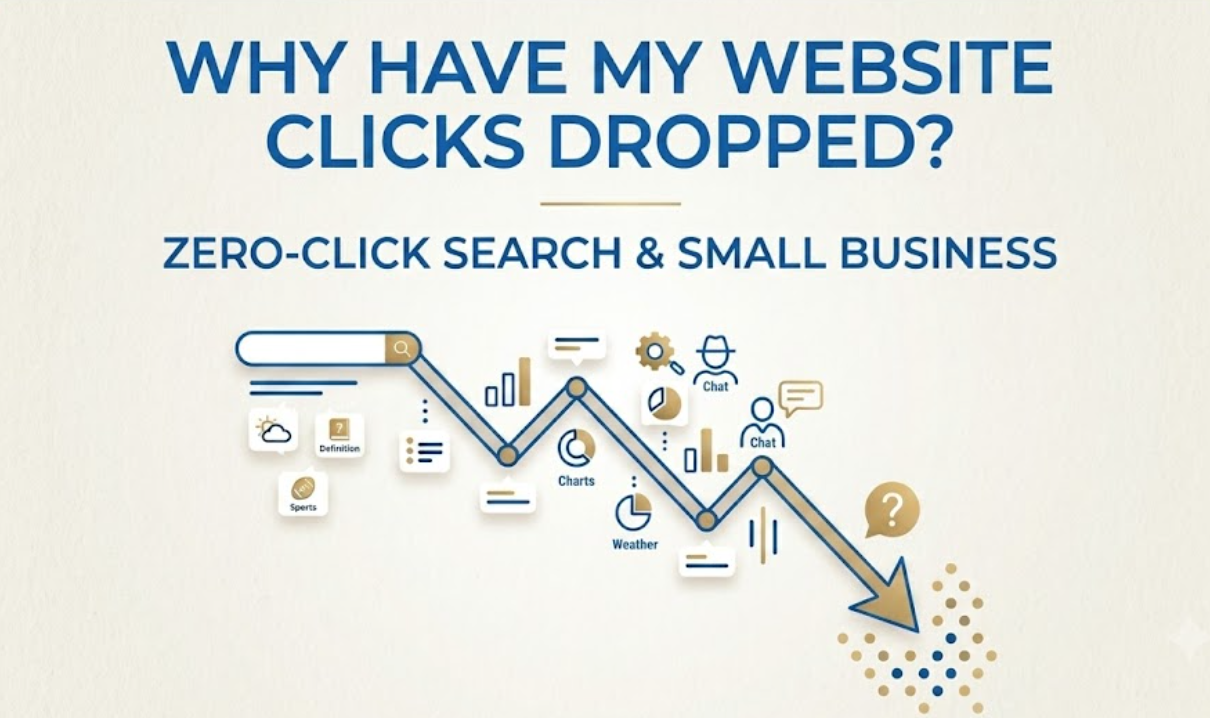
Zero-click search is when Google or another search engine answers a user’s question directly on the results page, often using AI Overviews, so the user never clicks through to a website.
If you’ve been checking your website’s analytics and seeing the same steady numbers month after month, but a drop in new leads and traffic growth, it’s not because you’re doing anything wrong.
Something bigger has changed, and it’s happening to almost every small business right now.
It’s called zero-click search, and it’s the reason Google isn’t sending you as many visitors as it used to, even when your content is ranking well. And because small businesses typically don’t have the marketing budgets or in-house SEO teams that big brands do, this shift hits harder.
What’s Actually Happening
For the last 20 years, someone typed a question into Google, Google showed a list of websites, and people clicked one to get their answer. That click was the whole business model of SEO.
That’s changing. Google (and other search engines) now try to answer the question right there on the results page, using AI-generated summaries, so people often never need to click anything at all.
Here’s what that looks like in plain numbers:
- When Google shows one of its AI Overviews at the top of the results, the website that would normally get the click sees its click-through rate drop by about 58% on average.
- Across all Google searches (as of June 2026), roughly 68% now end with the person never clicking a website at all.
So your content might still be getting found, read (in a sense), and used by Google, and your impressions can still be high, but fewer of those people are actually landing on your site. That’s not a content problem.
It’s a structural shift in how search works.
Why Your Website Analytics Look Confusing
This shift creates a pattern in your numbers that’s easy to misread as “our content stopped working”:
Old model: Someone searches → sees your listing → clicks → visits your site
New model: Someone searches → gets an AI-written answer → question is answered → maybe clicks through if they want more
That “maybe” is the key. A smaller number of people are clicking, but the ones who do click already read a summary and decided your site was worth a visit anyway. That means:
- Impressions stay flat, clicks don’t grow. Google is still crawling and citing your content; you just aren’t getting the traffic credit for it the way you used to.
- Basic “what is X” content takes the biggest hit. If your blog is full of general explainer posts written mainly to attract traffic, expect those specific pages to lose anywhere from 50% to 89% of their clicks. AI Overviews are built exactly for questions like these.
- The people who do click are much better leads. Someone who read an AI summary, looked at the sources, and still chose to visit your website already did their homework. They’re not casually browsing. They’re genuinely interested. Early data suggests these visitors convert at noticeably higher rates than average search traffic used to.
For a small business, this matters even more than it does for a big brand with traffic to spare. You may not be able to out-produce large competitors on content volume, but you don’t need to. A smaller number of high-intent visitors who are ready to buy is worth far more than a larger number of casual browsers. So the win isn’t “get more clicks.” It’s “get chosen as the source AI cites, and make the clicks you do get count.”
Three Tips to Adapt to Zero-Click Searches

You don’t need to abandon blogging or SEO because of AI. You need to write content in a way that both AI tools and real readers can use easily.
1. Answer the question immediately
Don’t make people (or AI) dig for your answer.
In the first sentence or two under any heading, give the direct, clear answer. Then go deeper with your real expertise, examples, and detail.
Think of it like a good customer service rep. Answer the question first, explain the “why” after. AI tools pull directly from content structured this way, and so do busy readers.
2. Cover the whole topic, not just one keyword
AI search doesn’t think in single keywords anymore. It thinks in follow-up questions. If someone asks about “commercial roof repair cost,” the AI is also going to want answers about warranty length, signs you need a repair vs. replacement, and how long repairs take.
If your blog post answers the obvious question and the natural follow-ups, you’re far more likely to be the source the AI actually pulls from and links to.
3. Make your site easy for search engines to “read”
This is the technical part, and it’s worth having your web person or agency handle it: adding structured data (called “schema markup“) to your pages. In plain terms, this is behind-the-scenes code that tells search engines exactly what your content is, whether an article, a how-to, a set of FAQs, who wrote it, and what business it’s from.
It doesn’t change what visitors see, but it makes it much easier for AI search engines (also called answer engines) to trust and cite your content as a reliable source.
To learn more about getting your small business website content used by AI, check out SEO & GEO in Atlanta | How to Get Found by AI
July 2026 Case Study for The Kool Source in Atlanta
This isn’t just theory. We can show you what it looks like with a Los Angeles property management blog we run for a client here at The Kool Source in Atlanta.
Over a 90 day period, our client’s site logged 37,889 total hits from AI search bots, including 11,774 in the one month and 2,713 in just 7 days.
Here’s the breakdown of our top AI search bot traffic over a recent 7 day period (in late July 2026):
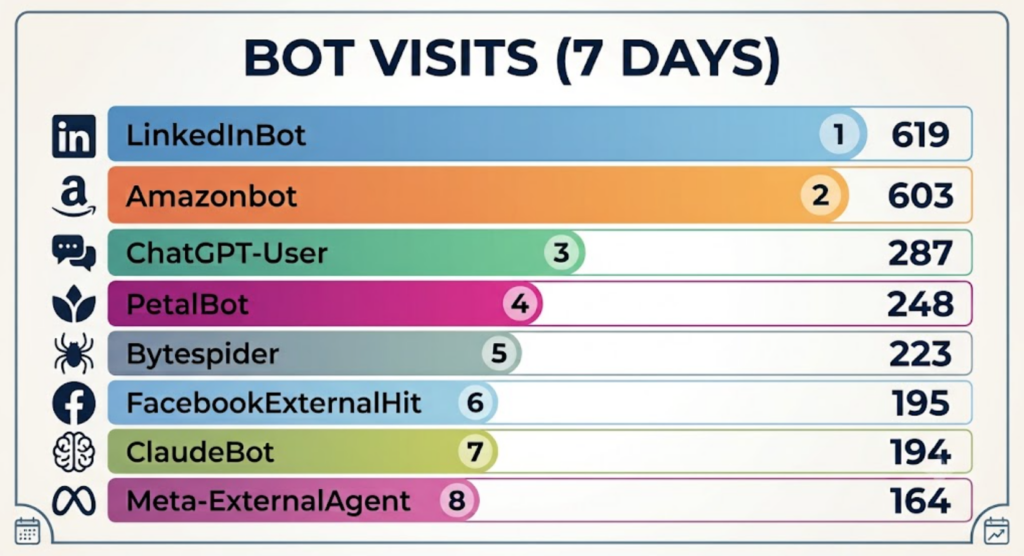
Most of these are indexing or training crawlers. They’re reading the content we create to understand and catalog it, but they don’t tell us much about what’s happening in the moment.
ChatGPT-User is different, and it’s the one worth paying attention to. This isn’t a background crawler. It’s OpenAI’s live fetch agent. It only shows up when a real person is actively chatting with ChatGPT, and it needs to pull a page in real time to answer their question.
In other words, every one of those 287 hits (over a 7 day period) represents a live moment where a relevant user asked ChatGPT a question, and ChatGPT decided our client’s content was worth reading to answer it.
Our raw server log backs this up with real examples from a single day. In just a few hours, ChatGPT-User pulled pages including:
- A Los Angeles rental market forecast
- An explainer on California’s rent cap law and what it means for LA landlords
- A guide on what landlords can legally charge for cleaning in LA
- Rent control laws specific to Pasadena
- A guide on renting out a house in Los Angeles
These are exactly the kind of specific, practical, local questions a landlord or property owner might type into ChatGPT instead of Google, and our content was the source it chose to answer with.
Bottom Line for Small Business in the Zero-Click Era
Your content marketing isn’t broken. The scoreboard changed. Raw traffic numbers don’t tell the whole story anymore. What matters now is:
- Getting cited as a trusted source inside AI-generated answers
- Earning the clicks that do happen, which tend to be higher-quality leads
- Structuring content so both AI tools and real customers can find their answer fast
Businesses that keep chasing the old traffic numbers are going to feel like they’re falling behind. Businesses that adjust to this new reality of answer-first content, full topic coverage, and clean technical setup are the ones that stay visible and keep generating real leads.
For a small business, that adjustment isn’t optional. It’s the difference between disappearing from the conversation and becoming the trusted name your customers (and AI tools) turn to first.
Ready to Turn from Zero-Click to Hero-Click?
If you’re a small business owner and you’re not sure whether your website is set up to get found, cited, and trusted by the tools your customers are already using, we’d be glad to take a look.

- Why Your Website Is Burning Your Google Ads Budget (And How to Fix It) - September 23, 2026
- 9 Marketing Fundamentals Every Business Should Know Before Using AI Tools - September 3, 2026
- Why Have My Website Clicks Dropped? Zero-Click Search & Small Business - July 31, 2026
0 Comments